

Table of contents
🪜 Building Clinical Judgment
Teaching nursing clinical judgment means moving students beyond memorization and into the highest levels of Bloom's taxonomy (analyzing, evaluating, and creating). That's easier said than done, especially when students are still building their foundational knowledge. What exactly are they supposed to "create" at this stage?
Here's a helpful reframe: we're not asking them to create something from nothing. We're training their brains to create a desired patient outcome, and then use clinical assessment and nursing interventions to get there. That's clinical judgment.
And with the right classroom activity, we can make that kind of thinking feel natural, even for students who are just finding their footing.
🎨Connecting creative thinking to nursing education
Educational consultant Patti Drapeau (2014) discusses the six criteria for students who are thinking creatively:
Express ideas that others haven't thought of
Choose their own way to demonstrate their understanding
Ask questions without fear of sounding silly
Enjoy open-ended assignments
Prefer to discuss ideas rather than facts
Like to try new ways to solve a problem rather than the accepted way
The activity I want to share allows students to demonstrate creative thinking. It is called the Six Thinking Hats and it was developed by Edward de Bono in 1985.
Using this in your classroom or clinical setting can help students practice decision-making, develop nursing clinical judgment, and incorporate creative thinking when approaching a problem. The activity guides students through various viewpoints and creates a decision-making tree in their minds that they can reference when faced with tough decisions requiring a creative solution.
🎩 How to implement the Six Thinking Hats Activity
Getting started with this activity is easy! You can download the template below to help you implement this activity.
Start with a problem
To start, give students a problem. For this example, students are presented with an ethical dilemma related to nursing practice.

Scenario: A new graduate nurse was hired into the float pool at your hospital. As a nurse in the oncology unit, you are assigned to orient the new nurse for the first four weeks.
During your first day, you review the protocol for a blood transfusion when she tells you that her religious beliefs will not allow her to administer blood products. As the shift goes on, she refuses to read the policy, will not go down to the blood bank to pick up the unit of blood, and is not in the room when you administer the blood.
Blood product administration is routine and occurs multiple times during a shift on this unit.
Ask students:
- "How should the nurse approach this issue?"
Have students write down their initial, knee-jerk reaction, and ask them to share their ideas. Then tuck these responses away to review at the end of the activity.
Analyze the situation from different viewpoints
Next, assign students to the different hat roles.
- 🧢 BLUE HAT - The blue hat is the leader, responsible for keeping the group focused, organizing the team's thoughts, and providing a synopsis of the group's work at the end of the activity.
- 📚 WHITE HAT - The white hat is the researcher and looks at the available data. In this case, the white hat student may share facts about Jehovah's Witness beliefs regarding blood product administration.
- 🥰 RED HAT - The red hat is a sensitive soul and brings up all the feelings that could result from a decision. These feelings can be happiness, sadness, anger, grief, or contempt. Anything that may arise.
- 🎨 GREEN HAT - The green hat is creative, thinks outside the box, and looks for an alternative, atypical solution to solve the problem.
- 🤝🏽 YELLOW HAT - The yellow hat is a peacekeeper and summarizes the benefits of the proposed idea. Does the solution benefit both parties? Would both sides be happy with the resolution?
- 🎩 BLACK HAT - The black hat is a pessimist and looks for potential negative impacts of the decision. Their job is to identify why the decision would not work and help the group eliminate or change aspects of the plan in light of negative consequences.
📝 Worksheet Template
Here is a worksheet template you can give to each group to help describe the role of each hat.
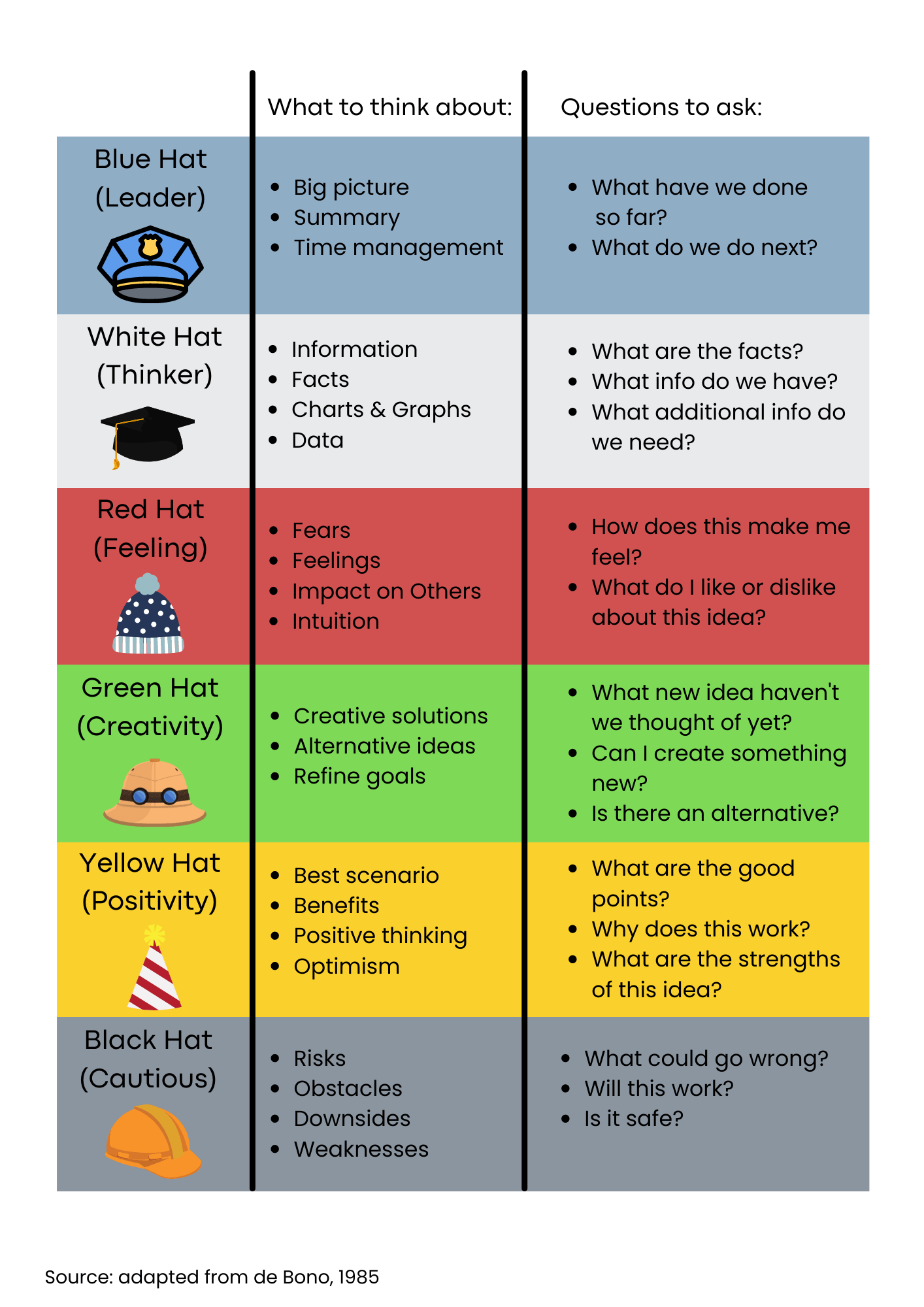
Group discussion
Once all of the students had had time to analyze the situation independently from the viewpoint of their hat color, the blue hat should lead the discussion, giving each hat a few minutes to share their thoughts.
Time for reflection
Finally, give the students time to reflect on the activity afterward. You can lead the debriefing session with these prompts:
Compare the student's initial reaction, as written, to their group's final idea. How did looking at the topic through the six hats change your initial opinion?
How can analyzing a problem from different viewpoints help you confidently approach a situation?
What new ideas emerged? Did you come up with a satisfactory solution?
🔄 Variations of the six thinking hats for nursing clinical judgment
In-Person Option
For beginner students, a safety case study could be an excellent way to introduce the six thinking hats.
For example, the scenario could be a confused, combative patient at risk for falls. Assign the students to the different hat roles, then brainstorm which fall-prevention precautions would be most effective.
🧢 Blue hat - Clearly defines the problem.
📚 White hat - What information do you have about the patient? Especially related to fall risk?
🎨 Green hat - What creative ideas are out there for fall prevention?
🤝 Yellow hat - Would the proposed fall precautions be a good fit for the unit's staffing? How would the patient's family feel?
🎩 Black hat - What could go wrong with this plan? Is there additional staff, patient, or family education involved? Is the necessary equipment/staff available?
For advanced students, you could use the six thinking hats activity to explore ethical dilemmas, review medication errors, or discuss how to prioritize care. In addition, instructors could utilize this activity in community clinicals or public health areas where resources are scarce.
In addition, the six thinking hats can be translated to interdisciplinary team member roles. For example, you could present a complex patient situation and have students put on the hat of a pharmacist, dietician, physical or occupational therapist, or case management nurse. Using the hats as interdisciplinary roles allows students to see the benefits of a team and how each specialty can enhance patient care outcomes.
Virtual Option
You could easily modify this for online synchronous learning by using breakout rooms and assigning roles to students within each room.
If you are teaching online asynchronously, assign six students to a discussion board and ask them to write the viewpoint of their assigned hat within the thread.
Students can take on more than one hat role if your groups do not divide evenly into groups of 6.
Clinical Option
Consider other professional situations or current events that new graduate nurses will encounter. These may include hospital systems lacking PPE, burnout and mandatory overtime, nurses' engagement in professional councils, and workplace violence.
⚡️ Build Your Own Six Thinking Hats for Nursing Clinical Judgment
The Six Thinking Hats for nursing clinical judgment helps develop creative problem-solving and nursing clinical judgment.
Start by choosing an existing case study, safety concern, or ethical dilemma that applies to the content in your class. Then, use the Six Thinking Hats diagram to assign a hat to each student and have them view the problem from this vantage point.
Consider alternatives to the hats as well, such as interdisciplinary team members.
Finally, debrief the activity by asking students to compare their initial reaction with their final response after considering the problem from multiple angles.
Conclusion
The Six Thinking Hats is one of those rare activities that feels like a discussion but quietly does some of the heaviest lifting in your classroom. It will help you to engage students at the top of Bloom's taxonomy without them realizing they've left their comfort zone. Here are three things to remember as you bring it into your teaching:
Start with a problem that has no obvious right answer. Ethical dilemmas, safety scenarios, and complex patient situations work best because they give each hat a genuine role to play and keep the discussion from collapsing into a single "correct" response.
The debrief is where the real learning happens. Asking students to compare their initial reactions with the group's final decision is a powerful moment of reflection that reinforces that clinical judgment requires more than instinct.
This activity scales easily. Whether you're teaching beginner students with a fall prevention scenario or advanced students wrestling with an ethical dilemma, the structure stays the same. Only the complexity of the problem changes.

Martha Johnson
Martha Johnson, MSN, RN is a nurse educator and the creator of BreakoutRN. She helps nursing faculty build active learning into the classroom and clinical setting, one practical idea at a time, using tools that support clinical judgment, engagement, and real-world nursing practice.
Frequently Asked Questions
How much class time does the Six Thinking Hats activity require?
A full run-through, including the scenario introduction, independent hat analysis, group discussion, and debrief, works well in a 45- to 60-minute block.
If time is limited, you can shorten the debrief or assign the initial hat analysis as pre-class preparation so students arrive ready to discuss.
What if my class doesn't divide evenly into six students per group?
That's not a problem. Students can take on more than one hat role, or in smaller classes, the whole group can work through each hat together in sequence. The blue hat role, the leader who keeps the group focused, can also be taken on by the instructor if needed.
Can this activity work in an online or hybrid course?
Absolutely. Breakout rooms are a natural fit for assigning hat roles in a synchronous virtual setting. You can use a shared document or digital whiteboard for each group to record their thinking, then bring everyone back together for the blue hat's summary and a full-class debrief.
It can also be done asynchronously via discussion boards.
The structure of the activity actually translates well online because each role gives students a clear, focused task to complete independently before the group discussion.

